For landownersOwn a stretch of chalk stream?
Many chalk streams were straightened, dredged wide or held back by old weirs. Much of that can be put right, often with free advice and grant money, and landowners are at the heart of it.
Check your stretchIs your river worth a look?
Pick your river to see what the Environment Agency records as holding it back, and which of those problems a landowner can do something about. It's a starting point, not a survey of your stretch.
The workWhat restoration looks like
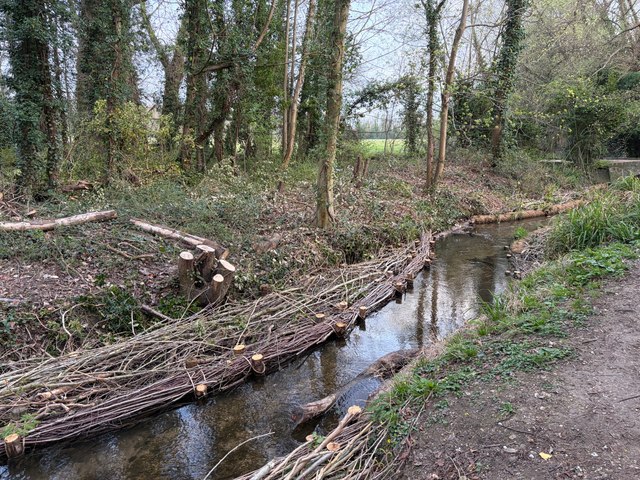
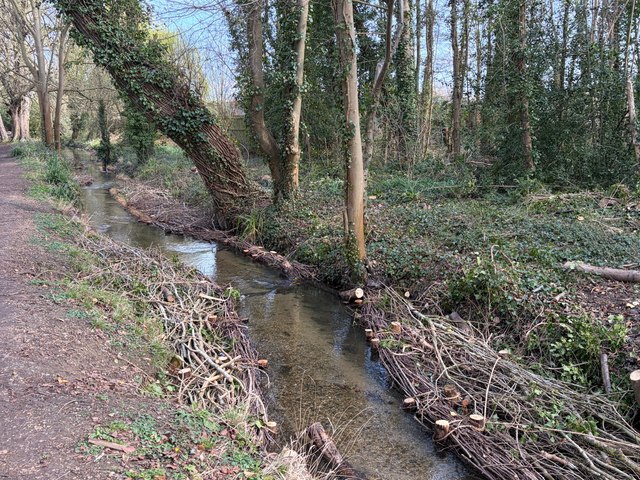
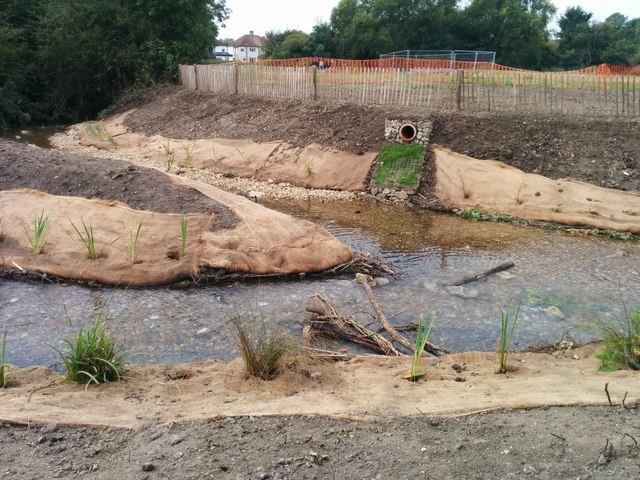
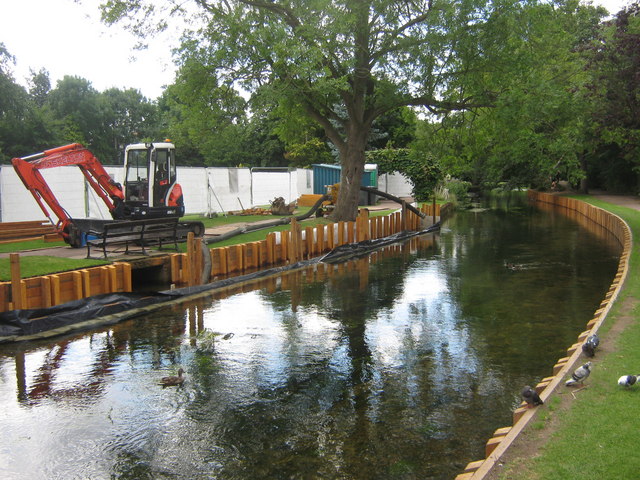
Most chalk stream work falls into two kinds. Soft restoration uses natural materials, often by hand, so the river reshapes itself: trees, brushwood berms, fencing. Hard restoration brings in machines to change the channel or its structures: new gravel beds, weirs eased or taken out. Soft work is cheaper and quicker to start; hard work fixes what soft work can't. Example of soft work on the Lark.
Start with an expert visit. A river specialist walks your stretch and writes a report on what is wrong and what could be done. This is usually the first step, and often leads to a funded project.
Source · checked 19 November 2026
Soft restoration · natural materials, light touch
Fallen wood
Whole trees or big limbs are fixed into the channel, staked, cabled to the bank or set in a trench. They push the current about, scour clean gravel, dig pools and give fish cover.
Cost and scale. Uses local material. Brushwood deflectors are cheap but take a lot of labour. Each piece of wood should reach about a third of the way across the channel to change the flow.
Source · checked 19 November 2026
Narrowing over-wide channels
Many chalk streams were dredged wide and deep, so the flow slows and silt settles. Pushing the bank edge 2 to 3 m into the channel, or building brushwood berms, makes it narrower and faster again so it keeps its own gravel clean.
Cost and scale. Bank-sliding with an excavator is described as low-cost and quick. Brushwood berms take more material and labour.
Source · checked 19 November 2026
Fencing and bankside strips
Keeping livestock off the banks lets plants grow back, holds the soil and stops silt washing in. On the River Piddle in Dorset, fish numbers rose once stock were fenced out.
Cost and scale. In a Game and Wildlife Conservation Trust study (in Cornwall), fencing cut silt in spawning gravel by about a third and raised trout egg survival by about half.
Sources (2) · checked 19 November 2026
Hard restoration · machinery, bigger changes
Putting gravel back
Where dredging took the gravel out, the bed is raised with stone and topped with washed gravel, or existing gravel is pushed back into the middle of the channel. Trout need clean, loose gravel to spawn.
Cost and scale. Raising the bed is the expensive option: a 50 m stretch of a 10 m wide river needs about 500 tonnes of material, plus modelling and usually a flood risk assessment. Reusing gravel already in the river is cheaper.
Source · checked 19 November 2026
Easing weirs and hatches
Old mill weirs and hatches hold water back, turning stretches into slow, silty ponds and blocking fish. Taking them out, notching them or adding a fish easement lets fish and gravel move again.
Cost and scale. Can be simple. On the Babingley in Norfolk, Norfolk Rivers Trust removed small weirs with a digger, with consent from the Environment Agency and the landowners.
Sources (2) · checked 19 November 2026
Five steps
- Look up your riverUse the check above or find your stretch on the map. Problems with the channel itself are the ones a landowner can most often fix.
- Get an expert visitA river specialist walks the stretch with you and writes up what could be done. The Wild Trout Trust's visits are free in England; your local rivers trust may visit too.
- Plan it and get permitsMost work in or beside a river needs an Environment Agency permit, and protected sites need Natural England's consent. A rivers trust or consultant can design the work and handle this.
- Find the fundingRestoration is usually paid for by a mix of grants, partnership money and private funding.
- Do the work, then keep watchingBefore and after surveys of fish, insects and plants show what changed.
Work by othersRestoration already done on chalk streams
These projects were run by rivers trusts, landowners, water companies and the Environment Agency, not by Chalk Streams. We list them from published sources so you can see what has worked. So far we have found 65 on 31 rivers; there are many more. See them on the map.
Kennet · recent (date not given)Benham Estate chalk stream restoration
The Benham Estate, working with Action for the River Kennet (ARK), restored 2.7 km of chalk stream, wet woodland and wet meadow on the Kennet SSSI, with volunteers helping and electric-fishing surveys to monitor the results.
Source · checked 19 November 2026
West Acre reach restoration
About 3 km of the Nar restored at West Acre by Norfolk Rivers Trust, the Norfolk Rivers Internal Drainage Board and contractors.
Source · checked 17 November 2026
STREAM project
A £1 million, four-year EU LIFE project led by Natural England, the Environment Agency, Wiltshire and Hampshire wildlife trusts and Wessex Water, restoring sites on the Avon and its tributaries.
Sources (2) · checked 19 November 2026
All 65 projects, river by river
Avon (Hampshire)- STREAM project · completed · 2006 to 2009
- River Avon Restoration Project · completed · 2011 to 2017 (multi-site)
- East Chisenbury restoration · completed · October 2009
Beane- Woodhall Park weir bypass · completed · October 2017 to January 2018
- Whitehall restoration · completed · 2014 to 2015
- Abstraction cut at the pumping station · completed · date not given
Bure- Upper Bure, Riverlands · completed · from 2018
Chess- River Chess Smarter Water Catchment · in progress · since 2020
- Chesham Moor channel enhancement · planned · autumn/winter (year not given)
Darent- Central Park, Dartford · completed · date not given
- Hawley Manor and Franks Lane · completed · date not given
- Darent Valley Landscape Recovery · in progress · date not given
Frome (Dorset)- Frome Headwaters chalk stream restoration · in progress · strategy 2024; target 2035
- River Frome Rehabilitation Plan · completed · 2010 to 2020 (multi-site)
Great Stour- Godinton · completed · date not given
- Godmersham, Milton and Canterbury · completed · date not given
- Kentish Stour Catchment Resilience Plan · in progress · April 2026 to September 2028
Hamble Brook- Hamble Brook re-naturalisation · completed · by 2024
Itchen- Test and Itchen structures removed · completed · by 2020
Kennet- Benham Estate chalk stream restoration · completed · recent (date not given)
- Marlborough restoration · completed · October 2020
- Sparkling Streams · completed · January 2021 to March 2022
- Reduced abstraction at Axford and Ogbourne · completed · date not given
Lambourn- Great Shefford fish passage and restoration · planned · project summary October 2025
- Restoring the Lambourn through Newbury · completed · date not given
- 800 m reach restoration · completed · 2006
Lark- West Stow Country Park · completed · September 2013
- Bell Meadow, Bury St Edmunds · completed · by 2018
- Mildenhall fish pass · completed · date not given
- Anglian Water schemes across the Lark · completed · date not given
Little Ouse- Blo' Norton pilot restoration · completed · October 2013
- Thetford re-meandering · completed · 1994
Meon- East Meon village channel · completed · by 2017
- Wickham sewage works upgrade · completed · date not given
Mimram- Archer's Green wetlands and ponds · in progress · from 2013
Misbourne- Amersham channel reconnection · completed · November 2020
- Barn Meadow and Pondwicks Meadow · completed · October 2023
- Lower Misbourne habitat work · completed · October 2017 to March 2018
- Mending the Misbourne · in progress · from 2025
Nar- West Acre reach restoration · completed · by 2016
- River Nar Restoration Project · completed · to March 2015
Pang- Englefield Estate restoration · underway · date not given
- Pang Flagship Chalk Stream Partnership · in progress · since 2022
Piddle- Fish passage on the Frome and Piddle · completed · date not given
- Little Piddle at Lyscombe · in progress · date not given
Rib- River Rib restoration · completed · 2026
Stiffkey- Warham to Wighton · completed · by 2024
- Fulmodeston · completed · date not given
- Swanton Novers headwaters · completed · date not given
Tarrant- Fish population study · completed · 2022
Test- Test and Itchen structures removed · completed · by 2020
Tiffey- Upper Tiffey fish pass · completed · recent
Ver- Hedges Farm restoration · completed · September 2019 to January 2020
- Revitalising the River Ver, St Albans · in progress · date not given
- Redbournbury Mill to Redbourn Road · planned · date not given
Wensum- River Wensum Restoration Strategy · in progress · ongoing, Natural England plan to 2027
- Upper Wensum restoration, phase 2 · completed · date not given
- Environment Agency and Norfolk Rivers Trust partnership · in progress · since 2020
Wylye- Wylye Valley Landscape Recovery · planned · launched April 2024
- Wider Wylye Strategy · completed · 2020 to 2025
- Seven Hatches restoration (STREAM) · completed · by 2009
Get in touchOwn or manage a stretch?
Tell us about your water and what you'd like to happen. We'll reply by email, and can put you in touch with people who can help. No cost and no commitment.